We are located in North Tulsa and currently train twice per week – Wednesday @ 4:30pm – 6pm, Saturday @ 9am – 11am.
Please contact us for the location if you would like to visit.
We are located in North Tulsa and currently train twice per week – Wednesday @ 4:30pm – 6pm, Saturday @ 9am – 11am.
Please contact us for the location if you would like to visit.
About our Wing Chun Curriculum
Wing Chun is a Chinese martial art that focuses on close‑range combat. Its core ideas are:
Because of these principles, Wing Chun is often described as a practical, street‑oriented style that lets a smaller person defend against a larger attacker.
Our lineage is Ip Man -> Leung Sheung -> Wong Siu -> Richard Verdugo
Leung Sheung – Studied directly under Ip Man and known for his deep understanding of the art’s fundamentals and for being one of the earliest teachers to spread Wing Chun outside the original school.
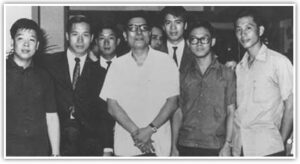
Leung Sheung (center), Wong Siu (far right)
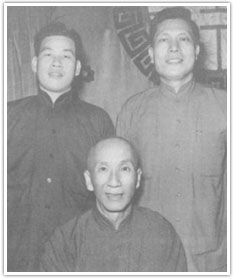
Ip Man (center), Leung Sheung (right)
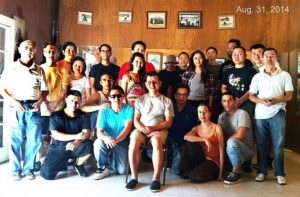
Sifu Wong Siu(center), Sifu Rich front row far right
Key points about Leung Sheung’s lineage
So, in simple terms, Wing Chun is a practical, close‑range fighting system built on efficiency and center‑line control, and Leung Sheung sits in the second generation of its modern lineage—trained directly by Ip Man and then passing the art on to several influential teachers who continue to teach today.
About our Mantis curriculum – Meihua Tanglang
Modeled after the movements of the praying mantis insect, blended with the “plum‑blossom” footwork of traditional Chinese martial arts. Gives the style a distinctive blend of swift, snapping attacks (mantis) and elegant, flowing stepping patterns (plum‑blossom). Small, rapid, diagonal steps that look like the petals of a plum flower opening. Practitioners shift weight constantly, staying light on the balls of the feet. Keeps the fighter mobile, makes it hard for an opponent to predict direction, and allows quick entry/exit from range.
“Hook” (Tang Lang Quan) – a curved, claw‑like hand that grabs or snags. • “Palm Strike” – a flat, downward palm used for breaking guard. • “Press” (Tiē) – a forward thrust of the forearm to push an opponent’s arm aside. Mimics the mantis’s fore‑legs, enabling precise trapping, joint‑control, and rapid striking. The style mixes soft, yielding motions (circular parries, redirection) with hard, explosive strikes (snap punches, elbow blows). Allows a practitioner to adapt to any situation—deflect a blow then counter with a sudden, powerful attack.
Chi Sau – While not identical to Southern Shaolin “sticky‑hands,” practitioners train to feel the opponent’s pressure and react instantly with hand‑to‑hand contact drills. This improves reflexes, timing, and the ability to exploit openings the moment they appear.
Philosophy – The “plum blossom” symbolizes resilience and renewal (the plum blooms in winter), while the mantis represents patience and precision. Encourages practitioners to stay calm under pressure, adapt quickly, and keep improving regardless of external conditions.
Typical training drills – • Foot‑work patterns – stepping through the eight‑direction “plum‑flower” diagram. • Mantis‑hand forms – a series of pre‑arranged movements that combine hooks, presses, and strikes. • Partner drills – light sparring focusing on trapping and releasing the opponent’s arms. Builds muscle memory for the characteristic foot‑step and hand‑technique integration.
Strategy – Close‑range striking and grappling. • Effective for defending against longer‑range attacks (punches, kicks) by entering quickly with the plum‑blossom steps. • Good for controlling an opponent’s limbs, setting up joint locks or throws.
These points capture the essence of Plum‑Blossom Praying‑Mantis Kung Fu for someone looking for a clear, practical approach to self defense.